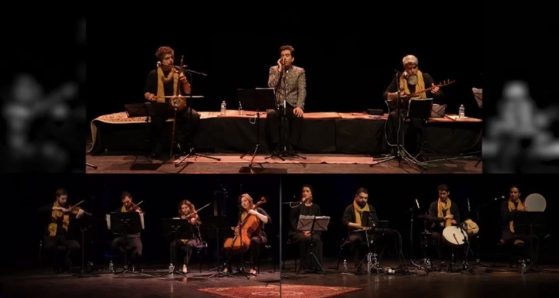
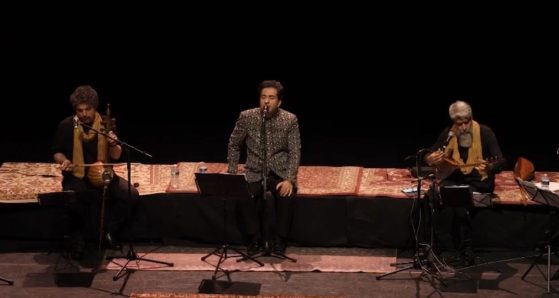
Hamdel Music Ensemble & Mohammad Motamedi
| Seyed Ali Jaberi | |
| May 24, 2025 | |
| 8:00 pm | |
| London, UK | |
| Sinfonia Smith Square |
The Poet Rumi, as he is now known in the West is more fully known as Mowlāna Jalāloddin-e Balkhi in Persian-speaking countries and Mevlana Celaleddin-i Rumi in Turkish. Rumi was born on September 30, 1207 near Balkh in eastern Khorasan (modern Afghanistan). Around 1216 His family made the long journey westwards across Iran towards Arabia as the Mongol invasion approached, and finally settled in Konya (ancient Iconium) in the area known as Rum in Anatolia, Turkey. He wrote mostly in Persian, but also in Arabic, and has been famed throughout the Muslim world as one of the greatest spiritual teachers of all time.
Rumi spent most of his adult life there, except for a period studying in Syria. H was the author of a great deal of poetry, including his great Divan of lyric poems dedicated to his own teacher Shamsoddin of Tabriz, and also his voluminous Masnavi, from which today’s recitations are translated. He died in Konya on December 17, 1273. Rumi is one of the best loved and most influential poets in Islamic culture, and nowadays his fame has ‘gone global’, thanks both to the popularity of modern popular versions and the interpenetration of the Muslim and ‘Western’ worlds in the post-colonial period.
The Poetry of the Masnavi of Rumi. A masnavi, a work of couplet verses, is a poetic genre in Persian and Arabic, usually long didactic Sufi works in continuous verse in a single metre. Rumi’s Masnavi (known as the Masnavi-ye Ma‘navi ‘the Spiritual Couplets’, is the longest and most famous of this genre, amounting to over 25,000 couplets (double verses) in six volumes.
It is popularly seen as a book of stories, but they are in fact stepping stones to long passages of Rumi’s discursive mystical teaching. The main theme is the human journey to unification with God, the source of all existence, through spiritual striving to union with the divinity known as Ḥaqq (‘truth’), the Beloved, the Friend, by opening the heart and mind to divine love and knowledge. The price for this unification is the sacrifice of the selfish self.
The harpist, once great and widely revered, has experienced physical decline in old age, mirrored in his lowly, impoverished state. He surrenders himself to the mercy of God, dreams a dream and experiences a sublime vision. In the meantime, the character of Omar, Commander of the Faithful, Second Caliph of Islam and greatest of all Muslims of his time, also experiences a dream, in which God speaks to him and instructs him what to do. The result is a transformation in the harpist as a result of his encounter with Omar, in which the harpist renounces and relinquishes all selfhood and transcends all mortal conditions. The story is a microcosm of the whole Masnavi.